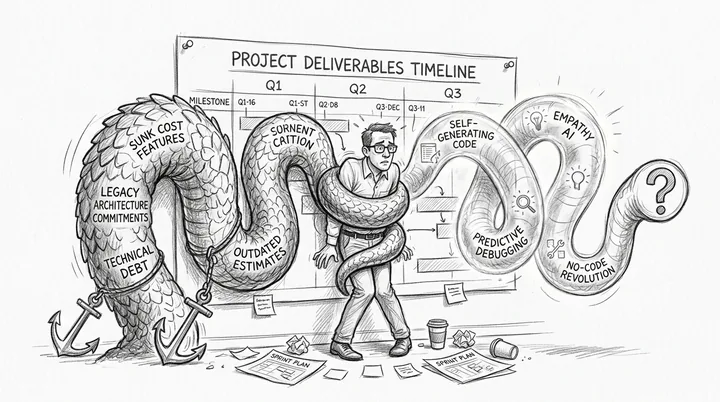
It doesn't live in your codebase. It lives in your roadmap.
The Temporal Tangle Worm slithers through time, coiled around past decisions you cannot easily undo and future promises you have not earned yet. Some of what feeds it starts as good judgment: teams should think ahead, notice when the tools are changing quickly, and avoid painting themselves into corners. The Worm appears when sensible foresight turns into devotion to a future version of the product, the platform, or the model stack that does not exist yet.
The future is arriving faster with generative AI than it has with any previous wave of technology. This is not a metaphor. The tools themselves are accelerating software delivery, which means the competitive landscape reshuffles every few months instead of every few years. A team that spent six weeks building a product around a specific model capability can wake up to find that a new release has made their product redundant. The ground doesn't just shift under you. It shifts while you're standing on it, and the Worm feeds on the vertigo.
Walk into any planning meeting for an AI-augmented product and you'll hear the same questions. Should we wait for the next model release before committing to an architecture? What's the right way to build against agentic security standards when those standards are still being written? Should we hold the release another month to see what gets announced next?
These are not hypothetical questions. They are the questions being asked in planning meetings across the industry, and every one of them is a segment of the Worm's body.
The Worm's core trick is making tomorrow's possibilities feel like today's obligations. "We should build for GPT-11 compatibility" becomes a real line item even though GPT-11 does not exist. "When the model gets better at code review, we will automate the whole pipeline" becomes a reason not to fix the pipeline the team already has. The roadmap starts drifting toward a future state that keeps receding because AI capabilities move faster than anyone can plan with much confidence.
The damage is not dramatic failure. It's a long season of neglect, the kind everyone can explain and nobody can justify. Features that users need now don't get built because the team is architecting for a future nobody can predict. Customer complaints accumulate. Churn increases. The team is building for a future that requires the customers they're currently losing.
Nothing feels done. Every release is a stepping stone to the real release. V1 is just a foundation for V2, V2 is just preparation for the AI-native V3. The product exists in a permanent state of becoming, never arriving.
The roadmap stops being a plan and starts behaving like a mood board. Teams that have been tangled for long enough stop distinguishing between "we are planning to do this" and "we hope we will be able to do this if the technology cooperates."
The counter-moves are not glamorous. Ban the phrase "when the next model comes out" from planning meetings. Plan with the tools you have, not the tools you hope for. At the start of each sprint, define what ships at the end — no future-state features, no "laying groundwork for next quarter," only work that produces user-facing value within the sprint boundary. Ship a prototype with today's tools, even if it's a little ugly, because real things generate feedback that anchors the roadmap in reality.
The Worm can't displace a team that's locked to a date. Deadlines are temporal anchors. The future will keep arriving. The question is whether you ship into it or wait for it.