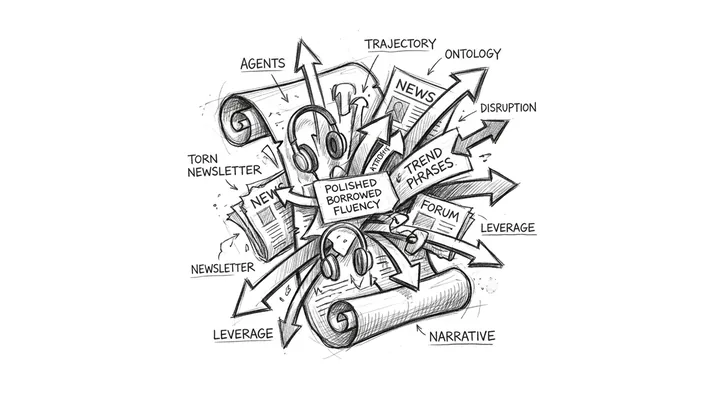
You know someone like this.
They can discuss AI capability trends with impressive fluency. They quote scaling laws in planning meetings. They reference a particular podcast episode, blog post, research paper, or newsletter with the confidence of someone who was present when the insight was formed.
Press on the details and the specifics dissolve.
They remember the conclusion but not the assumptions. They recall the headline but not the method. They know what the experts think. They have not built anything themselves.
This is the Scroll of Borrowed Fluency: a curated collection of podcast transcripts, blog posts, research papers, newsletters, and summaries treated as a substitute for direct experience.
The Scroll is always growing. Every week brings a new episode, a new essay, and a new paper that might change everything. There is always one more thing to read before it is time to act.
Why experiment with a tool when you can read what someone smarter said about it?
Familiarity is not working knowledge
The Scroll produces a particular kind of secondhand expertise. Its holder may not be able to troubleshoot a broken pipeline, but they can explain what leading thinkers say about pipelines. They may not know which model settings their own team uses, but they can quote a theory about why those settings matter.
The Scroll gives them the shape of knowledge without its weight.
In a room full of people who have not read the same sources, that shape can be enough to sound authoritative. It becomes harder to maintain when the system breaks.
Someone who has spent a hundred hours building with a tool knows where it behaves strangely, which errors are misleading, and which shortcuts fail under load. Someone who has spent a hundred hours consuming content about the tool knows what experts think about it.
Those are different forms of knowledge.
Only one helps when the pipeline breaks at two in the morning.
The feeling of being almost ready
The Scroll’s most damaging effect is not ignorance. It is the feeling of permanent almost-readiness.
The holder has one more podcast episode to hear, one more newsletter to skim, and one more paper to understand. This feels like preparation. It can even look like preparation from the outside. The person is curious, informed, and engaged in the conversation.
But curiosity becomes an excuse when it never ends in a decision or an experiment.
AI makes the substitution easier. A model can summarize a difficult paper in seconds, explain the conclusions, define the terms, and produce a list of practical implications. You may finish the exchange feeling as if you read the paper.
You did not read the paper. You received a fluent account of someone else’s account of it.
That account may be useful. It may also omit the limitations, flatten uncertainty, or confidently fill in a gap. The danger is not that summaries are always wrong. The danger is that they make familiarity feel earned.
Use reading as a launchpad
The Scroll is not useless. Curated reading combined with hands-on work is valuable. Documentation can save time. Research can prevent bad assumptions. Other people’s experience is worth learning from.
The problem begins when awareness replaces action rather than leading to it.
If you read about retrieval-augmented generation, build a small one. Put real documents through it. Ask an inconvenient question. Inspect what comes back. Change the chunking strategy. Break the retrieval step and see what the application does.
If you read that a coding assistant improves productivity, use it on a task your team actually owns. Track where it helps and where review cancels the savings. If you read about a new framework, install it, make one request, and find the first rough edge.
The experiment does not need to become a product. It needs to become evidence you earned.
A practical rule is to pair every substantial block of reading with a small act of construction. Read the paper, then reproduce one result or test one claim. Watch the talk, then try the workflow. Read the model announcement, then run it on a task that matters to you.
The Scroll will still be there afterward. You may understand it better because you tried.
The cure for borrowed fluency is not less reading. It is putting some weight behind the words.
Go build something. Break it. Fix it. Read the error messages. Then return to the Scroll with evidence of your own.