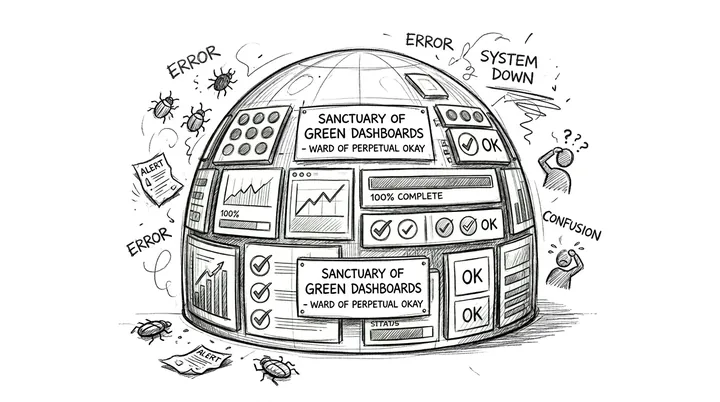
The dashboard is green. All of it.
Build success, test coverage, deployment frequency, review completion: every metric sits in the safe zone. The sprint review went well. The velocity chart looks healthy.
Outside the dashboard, users are filing bug reports.
The Sanctuary of Green Dashboards appears when a team measures process compliance instead of outcome quality. An AI scanner reviewed the code. AI-generated tests passed. Documentation exists, although nobody reads it. Every indicator is green.
The software is not.
How the sanctuary gets built
It begins with a reasonable goal. The team wants visibility, so it tracks build status, coverage, pull-request reviews, deployment frequency, and other signals that seem to describe engineering health.
Those signals can help. The problem begins when the signals become the thing being optimized.
AI makes that substitution easy. It can generate tests, review summaries, documentation, and quality scores in seconds. The output looks complete, and the dashboard gains another green box. Soon the team is measuring whether the process produced artifacts rather than whether those artifacts found a problem.
Coverage rises because the AI wrote tests to match the implementation. Review completion rises because a scanner approved the syntax. Documentation coverage rises because every function has a paragraph attached to it. Deployment frequency rises because the pipeline is fast.
None of those numbers answers the question that matters most:
Does the software work for the people using it?
When process becomes proof
A passing build tells you the build passed. A completed review tells you that a review step occurred. Neither tells you that the checkout flow works under real conditions or that someone noticed the dangerous assumption in a change.
AI-generated work can tighten the loop while making the loop less independent. The same system generates the implementation, writes tests that reflect the implementation, summarizes the review, and feeds the result into the dashboard.
Each stage appears to validate the previous stage. No independent challenge has happened.
It is possible to automate every ceremony and never ask whether the original behavior was correct.
That creates delayed learning. Customer complaints get explained away as edge cases. Production evidence feels less trustworthy than a row of green checks because the checks are familiar and belong to an approved workflow. The team has built a system that reassures it about its own work.
The problem is not that automated checks are useless. The problem is asking them to prove something they cannot prove.
Ask the rude question
"The dashboard says green, but does the software actually work?"
That question should move attention toward evidence that is harder to manufacture.
Are users completing the task they came to complete? Are error rates changing after a release? Are support requests concentrated around a new workflow? Do tests describe expected behavior, or do they merely repeat the implementation? Can a reviewer explain what could go wrong?
Keep the build check, but pair it with signals from real usage. Keep coverage, but inspect whether tests exercise meaningful behavior. Keep automated review, but reserve human attention for decisions and assumptions a syntax scanner cannot judge.
For AI-generated tests, ask what would fail if the implementation were wrong. Change the implementation slightly and see whether the tests notice. Add a case from production. Review the test before trusting the percentage.
For documentation, measure whether another developer can use it to answer a real question. A paragraph attached to every function is not automatically useful documentation. Sometimes a short explanation of a boundary is worth more than pages of generated summaries.
For deployment frequency, look at what reaches users and what happens afterward. A team that ships quickly but creates support work is not necessarily moving faster. The dashboard should make that visible.
An honest dashboard may produce uglier numbers. That is its job. It should expose uncertainty, show where users struggle, and create questions that lead to better software.
Green is a status color. It is not a verdict.