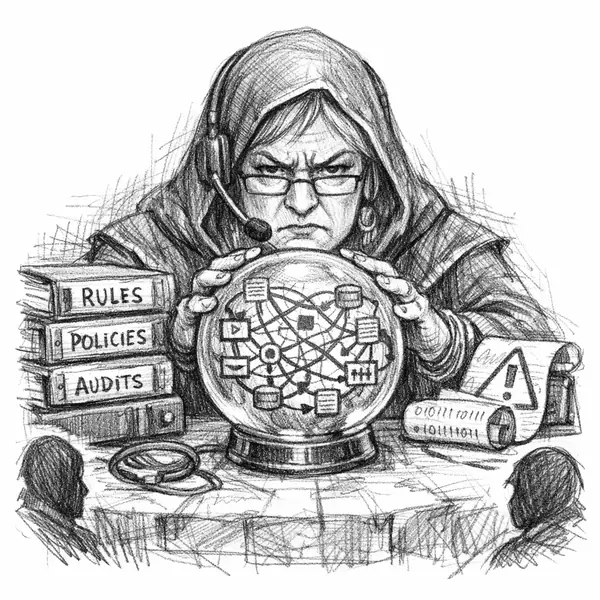
The governance characters in an AI adoption story all share one trait: they are always one version behind.
The Policy Paladin carries the Governance Framework. It is comprehensive, cross-referenced, and color-coded. It covers every scenario the organization worried about when the document was written.
Then someone checks the version history.
The framework describes the AI systems the organization deployed six months ago, not the systems people are using now. Version 4.2 is thorough. It was also written before the current tool existed. Version 4.3 is in progress, waiting on Legal. Legal is waiting on Security. Security is waiting for a clearer picture of what the new capabilities actually do.
By the time everyone agrees on the update, the team has moved on again.
This is not a story about lazy policy work. The people involved are usually doing exactly what their roles require. They are trying to document risk, establish controls, and give the organization a defensible position. The problem is the speed mismatch. A policy review may take weeks or months. A new AI workflow can appear in an afternoon.
The document loses contact with reality long before anyone formally declares it outdated.
The checklist problem
The Risk Assessor treats AI risk as a checklist exercise. The checklist includes familiar items: data residency, access controls, audit logs, and vendor review.
Those controls still matter. They just do not describe the whole risk surface.
AI systems introduce failure modes that traditional software checklists often miss. Model behavior can change. Prompts can expose information that developers did not expect to leave the system. A prompt injection can redirect an otherwise trusted workflow. A model can produce a confident but incorrect answer that ends up in a consequential decision. Training data can leak into output. A system can pass a review and still behave badly once users discover new ways to use it.
The Assessor runs through the list, checks the boxes, and declares the system compliant. The system is compliant with a framework that may not describe what the system actually does.
That distinction matters. A clean checklist can create more confidence than a messy reality deserves.
The map problem
The Compliance Cartographer has a similar problem. The Cartographer maps the regulatory environment: the EU AI Act, state-level AI laws, and industry-specific rules.
The maps may be accurate and carefully maintained. They are also difficult to keep current when the technology and the rules move at different speeds. A legal review can describe what the organization knows at the time of review. It cannot automatically account for a new model, a new integration, a new user group, or a workflow that grew beyond its original purpose.
The work remains valuable. It is simply never finished.
The shared pattern is reactive governance. The tool ships. The team uses it. Governance tries to catch up. Sometimes it does. Sometimes it produces a document that looks current while describing an older system.
That gap between adoption and governance is where the risk lives.
Test reality, not paperwork
The practical counter is a reality test.
Pick three AI workflows currently running in production. Do not start with the policy document. Start with what users and systems actually do. Then walk each workflow through the governance framework.
Ask:
- Does the framework identify the data the workflow receives?
- Does it describe where the output goes?
- Does it account for the people who rely on that output?
- Does its risk classification fit the real consequences of failure?
- Does it identify who can stop the workflow?
- Does it cover the model, prompts, integrations, and downstream actions involved?
If the categories describe the workflows, the framework may be current enough to use.
If you find yourself saying, "This workflow does not fit any of the categories," stop there. That mismatch is more useful than another round of formatting or policy language. It tells you where the organization is operating outside its own controls.
The NPCs are not the villains. The Policy Paladin, Risk Assessor, and Compliance Cartographer are trapped in a process that assumes the thing being governed will remain stable long enough to document.
It will not.
Governance has to move closer to the work. Review real workflows, not just proposed ones. Revisit the classification when a tool gains new capabilities or new users. Assign someone to own the gap between the written control and the system people actually use.
A policy that describes yesterday's tool is not useless. It is just not evidence that today's system is safe.