Do you remember planning meetings before generative AI existed? They were actually difficult. You had to sit in a room with human beings and have a real discussion about what you could spend your time on, what was worth building, what could wait. Things took time to do — researching a feature idea meant actually researching it, and writing up a proposal meant actually writing it, and the friction of doing that work was part of what kept the backlog honest. You couldn't just propose something — you had to actually write the proposal, and you couldn't just ask generative AI to write it for you. You couldn't propose fourteen things because it would have taken fourteen hours to discuss them, review them, generate all the documents, do all the planning. Now, because of generative AI, everything is magical and instantaneous, and that's actually causing some problems.
Now planning meetings are sort of a fun little non-conversation. You walk in, someone says "let's do this and this and this and this," and they just keep going. Every idea that would have taken a day to research takes seconds. Every proposal that would have died in someone's head because writing it up felt like too much effort now arrives fully formed, polished, individually defensible, and guess what? Completely unread. People can generate proposals faster than they can even read them. The cost of proposing has collapsed. The cost of deciding has not.
And here's where it gets dangerous. A lot of companies are starting to cancel the planning meeting entirely, because why bother? If you can use generative AI and move so quickly, why do you need to plan? The meeting feels like overhead. The discussion feels like a bottleneck. So you press the gas pedal on generative AI and you stop having the conversation about what's being decided — and what happens is that generative AI is now running the plan, and generative AI is creating a backlog that grows at a velocity greater than the number of issues you could ever complete.
That's the Infinite Backlog Engine. AI is excellent at speeding up execution. It writes code, drafts plans, produces requirements, scaffolds the materials of work — all faster than the team could produce them manually. But it is equally excellent at filling the backlog, and backlog-filling has no natural ceiling. An AI can generate fifty proposals in the time it takes a team to evaluate one. The team ships faster than ever, and the backlog grows faster than ever, and the second outpaces the first, because execution requires judgment and backlog-filling does not.
Here's another problem with the backlog. Somebody has an idea, and then it sits there for days, weeks, maybe months, maybe years, and when somebody eventually picks it up they might not even know who put it on there or why. So you're constantly confronted with a backlog of ideas, action items, and unfinished thoughts where nobody remembers how those things got there in the first place — and that's a problem, because a backlog you don't understand the origin of isn't a plan, it's just a pile.
Nobody reads the proposals because they look like something that was already evaluated, and evaluating them again feels redundant. The organization produces more proposals than ever, they get approved faster than ever, and the core product moves more slowly than ever.
The backlog tends toward infinity not because anyone is failing, but because the system has two accelerators and one bottleneck. Both accelerators are AI. The bottleneck is the human judgment required to decide what matters. You can't scale the bottleneck by running more models, because deciding is far less fun than generating, and deciding is slow — so why not just generate an infinite backlog? It gives you a sense of accomplishment. You can only scale it by choosing fewer things — which feels like going backwards in a culture that just learned to produce at scale.
The counter-move is not to generate less. It's to select more explicitly. Fewer priorities treated as a feature rather than a constraint, public discussion of what was not selected and why, and a norm that adding work to the plan requires a named reason for why something else comes off. And "adopted by" — someone must be named as having read the plan, understood it, and taken responsibility for it.
If a meeting about priorities cannot produce a single exclusion, the meeting was about the backlog, not about priorities. And a meeting about the backlog is a meeting that the Engine scheduled.
The friction that AI made cheap was always doing something: it was selecting. The Engine is what happens when that friction disappears and nobody rebuilds it on purpose. You sign over your planning to AI, don't be surprised when you look up and see an infinite backlog staring back at you.
HQ 8 — Authored. Drafted from dictated notes, revised by hand, AI used for grammar and polish only.
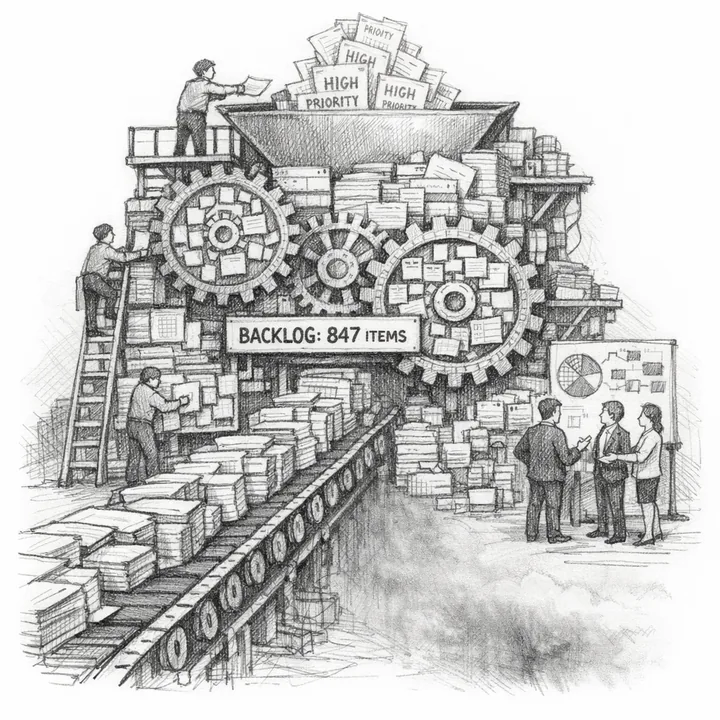
The Infinite Backlog Engine is one of the monsters in The AI Developer's Field Guide, a field guide to the anti-patterns AI brings to software engineering.