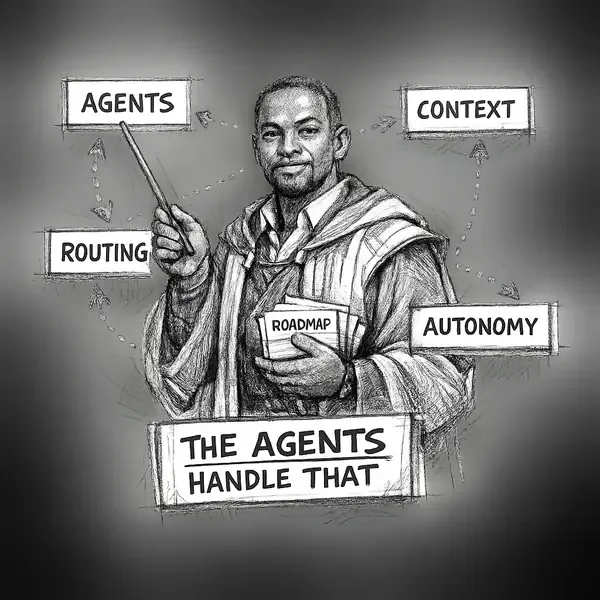
Every organization adopting AI has one. The person most fluent in agentic vocabulary. The one who can narrate what the system is doing with enough institutional credibility that the organization begins mistaking explanation for control.
The Agent Whisperer is not necessarily wrong about what the system can do. The Whisperer is wrong about what the organization should therefore feel confident about. Their signature move is making the monster sound reasonable — walking into a room and describing what the agentic future looks like with enough fluency that the room starts treating it as the present tense.
The Whisperer may be an architect who has been thinking deeply about these systems. They may be an internal champion who is genuinely excited about what is possible. They may be the person most comfortable speaking in agentic future tense, which is a real and recognizable professional skill in the current moment. The Whisperer's contribution to the monster is not building it alone. It is making it sound like the right direction to go.
Here's the problem. The language of agency is exciting, and it is easy to describe what a system might do in ways that make the description sound more settled than the system actually is. Describing an agentic workflow as though it were a reliable actor is easier than describing it as a probabilistic system operating in conditions it was not designed for. The exciting description gets more attention in the room. The honest description sounds like a killjoy. And so the exciting description travels further, and the organizational understanding of what the system actually is becomes less accurate rather than more.
The agent decided is a sentence that answers the question of what happened without answering the question of who is responsible for whether it was the right thing to decide. We used AI to determine customer sentiment is a sentence that answers the question of methodology without answering whether the methodology was adequate for the stakes of the decision it was informing.
The Agent Whisperer provides the vocabulary that makes these sentences feel natural. They don't have to be dishonest. They just have to be fluent enough that the organization stops asking whether the fluency is backed by demonstrated reliability.
The mirage becomes dangerous whenever generated output starts substituting for listening, reading, validation, or accountability — not replacing them, but substituting. A system that assists human judgment is doing something useful and bounded. A system that displaces human judgment, by making the human feel that their contact with the actual problem is optional, is doing something more dangerous, because the gap between the system's output and the human reality it was meant to represent is now invisible. Nobody is checking. And the whole thing looks like it is working, because the output is fluent, confident, and present in the documentation.
The counter-move is simple and uncomfortable: require named human owners for every agentic workflow. Not the team. Not the system. A person. If the agent drafted the requirement, who decided it was worth drafting? If the model simulated the customer to generate synthetic feedback, who approved that synthetic feedback as a substitute for real customer contact? If a workflow took action across a system, who can explain what happened and why the action was the right one?
These questions sound like process theater. They are not. They are the connective tissue between AI output and organizational accountability. The questions are only theater when nobody is expected to answer them — when the questions exist in a document but not in the operational reality of the team. When someone is expected to answer them, and when the expectation is backed by the authority to say not like this, they are the structure that prevents the mirage from becoming something worse.
The chain of human accountability terminates at the last human. Make sure that human has a name, and make sure the name belongs to someone who is still in the loop.
The Agent Whisperer is one of the NPCs in The AI Developer's Field Guide, a field guide to the anti-patterns AI brings to software engineering.