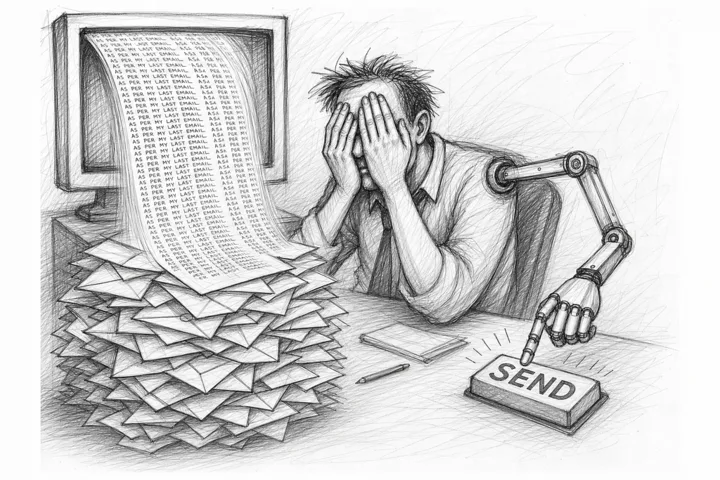
People are getting sick of your AI output. They really are.
We’re three years into this. Maybe a little less, depending on when you started. And the pattern is the same everywhere. Someone generates a document, an email, a proposal, a report — whatever — using an AI tool. They glance at it. (Maybe they don’t even glance at it?) Then they hit send.
And the person on the other end opens it and thinks, "What the #$%@ is this? You didn’t even read this. You haven’t even read the thing you’re sending me.”
That’s not a productivity gain. That’s a redefinition of “phoning it in.”
Here’s the rule. It’s not complicated. If you’re going to send it, you must read it. All of it. Every sentence. If you can’t be bothered to read what you’re sending, why should anyone else?
If you’re not going to read it — if you’re using AI to generate something and sending it along without investing time in understanding what it says — then you need to put a disclaimer on it.
Email Disclaimer: “I’m very lazy. This is raw AI output. I’m sending it as a starting point. I haven’t reviewed it because I have very little respect for you.”
At least then the recipient knows what they’re getting. They know you’re not vouching for it. They know it’s a draft, not a deliverable.
But here’s the thing about that disclaimer. Once you start putting it on things, you start to realize how often you’d have to use it. Every email. Every document. Every proposal. “This is raw AI output.” After a while, you have to ask yourself: what exactly is your contribution here? If everything you send comes with a disclaimer that you didn’t read it, what are you actually doing?
The problem isn’t using AI. The problem is skipping the part where you engage with its output. The reading. The rewriting. The curating. The part where you look at a sentence and think, “That’s not what I meant,” and you fix it. The part where you read a paragraph and realize it sounds like every other paragraph on the internet, and you make it sound like you.
That takes time. It’s supposed to take time. The AI can generate the first draft in thirty seconds. The reading and rewriting might take thirty minutes. That’s not a failure of the technology. That’s the work. The technology got you to the starting line faster. But it cannot run the race for you. You still have to think about words and write.
And then there’s the curation part — the careful effort to decide what goes into what you’re writing in the first place. What’s the input? What’s the context? What are you asking the AI to do, and why? The quality of the output depends on the quality of the input, and the quality of the input depends on how much thought you put into the request.
For most of these emails, it isn’t just apparent that you didn’t bother to read them; it’s also apparent that you sent them a one-sentence prompt and gave up.
If you don’t invest time in reading, editing, and rewriting what you’re sending, don’t send it. That’s it. That’s the whole post. Your judgment is what makes the output worth reading. Without it, you’re just a relay — passing along something a machine wrote to a human who has to figure out what to do with it.
Nobody wants to be on the receiving end of that. And if you keep doing it, people will stop opening your messages. Not because they’re anti-AI. Because they’re pro-their-time. And you’re wasting it.
Read it. Rewrite it. Or don’t send it.
I keep hearing the same complaint from people who aren’t even particularly technical: “Everything in my inbox is the same.” Same structure, same tone, same phrases, same bullet points.
They can’t always tell you it’s AI-generated, but they can tell you it wasn’t written by someone thinking about them.
That’s becoming a character in its own right — the person who outsources their communication to a model and then wonders why nobody reads their emails. I’m starting to think this might be a new monster for the Slop Codex. The book already has the Phantom Intern — the AI that does the work while you pretend you did it. But this is different. This is someone who isn’t even pretending. They’re just forwarding. The Relay, maybe. The Conduit. Something that captures the specific failure mode of generating output and hitting send without ever passing through the sentence yourself.